
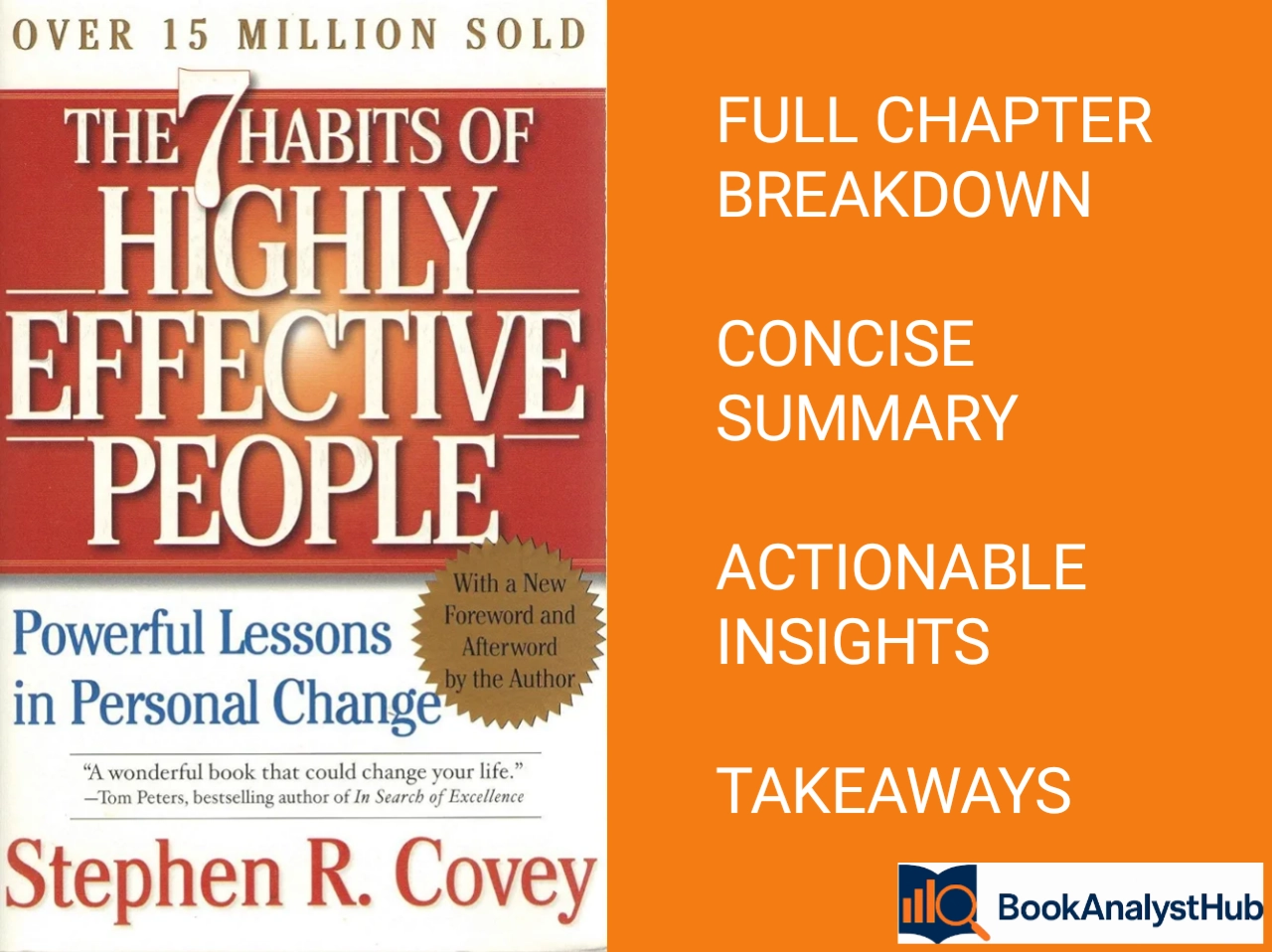
“The 7 Habits of Highly Effective People” is a classic self-help/business book by Stephen R. Covey. It belongs to the genre of personal development, leadership, business effectiveness, and management. The book offers a principle-centered approach to personal and professional growth.
Covey argues against quick-fix “personality ethic” techniques common in many self-help books. Instead, he promotes the “character ethic” — building deep, enduring habits grounded on universal, timeless principles (honesty, integrity, responsibility, respect).
The book is structured around seven habits — first to achieve independence (self-mastery), then interdependence (effective collaboration with others), and finally sustaining long-term effectiveness through renewal.
Given your interest — entrepreneurship, business and investment — this book is foundational. It’s not about hacks; it’s about core character, mindset, and leadership principles that shape decisions, relationships, productivity and long-term success.
📖 Chapter-by-Chapter Lessons & Interpretations
Below is a breakdown of each habit (chapter), with at least five practical lessons drawn from Covey’s work — expanded with analogies, step-by-step logic, and business-oriented examples to help you internalize them.
Habit 1: Be Proactive
Core Idea: You are the programmer of your life — not just a product of external circumstances. Between a stimulus (what happens to you) and your response lies your power to choose.
5 Practical Lessons and Actionable Insights:
- Focus on What You Can Control (Your Circle of Influence):
- Analogy: Imagine you’re a farmer. You cannot control the weather (rain or drought), but you can control how well you tend your soil, plan irrigation, select crops, and care for them. Similarly, you can’t always control external conditions — the economy, market shifts, other people — but you can control your actions, decisions, mindset, responses.
- Business Example: In entrepreneurship, you may not control the entire market demand, but you can control your product quality, customer service, pricing strategy, marketing. A proactive company focuses its energy where it can influence outcomes.
- Take Responsibility for Your Life and Choices:
- Logic: When you accept that you are responsible for your reactions and path, you shift from being reactive (victim of circumstances) to being proactive (actor). This gives you empowerment — you own your success or failure.
- Example: If you’re investing and markets fall — a reactive person panics and sells; a proactive investor reviews fundamentals, adjusts strategy, maybe even seizes opportunity.
- Initiative Over Passivity — Act Before Being Forced To:
- Analogy: Think of a captain steering a ship in rough seas. A reactive captain waits for waves to push the ship; a proactive captain adjusts course early, uses wind, anticipates storms.
- Business Example: Rather than waiting for cash flow problems to force cost-cutting, a proactive entrepreneur regularly reviews expenses, forecasts cash flow, diversifies revenue — preventing crises.
- Control Your Attitude — Your Internal Response Matters:
- Logic: You cannot always change external events, but you can choose your mindset. A positive, solution-oriented attitude enables creativity, resilience, perseverance.
- Example: When facing failure (a product flop, a bad quarter), a proactive CEO doesn’t doom-scroll — they analyze what went wrong, learn, pivot strategy, keep morale up.
- Expand Your Influence by Investing Where You Can Grow:
- Analogy: Plant seeds where the soil is fertile. The more you invest in your character, skills, relationships, the more your “circle of influence” grows — giving you power to impact larger outcomes.
- Business Example: A leader who continuously builds trust with team, nurtures talent, invests in relationships will expand influence — which helps in partnerships, alliances, brand growth.
Habit 2: Begin with the End in Mind
Core Idea: Everything is created twice — first mentally, then physically. Before you act, visualize the outcome. Have a clear mission statement or vision to guide your life and decisions.
5 Practical Lessons and Actionable Insights:
- Clarify Your Vision and Purpose — Know Where You’re Going:
- Analogy: If you set out on a journey without a destination, you might wander endlessly. But if you know your destination, every step becomes meaningful.
- Business Example: A startup founder who envisions “serving 1 million underserved customers with affordable solutions” will structure operations, product design, and marketing around that vision, rather than wandering from trend to trend.
- Write a Personal Mission Statement — Align Actions With Values:
- Logic: When you codify your core values and mission, you create an internal compass. Every decision — big or small — can be tested against that compass: “Does this help me reach the end I envision?”
- Example: A business leader might commit to “ethical business practices, long-term value creation, treating employees as stakeholders.” This affects hiring, partnerships, investments.
- Prevent Short-sighted Moves — Avoid Throwing Good Time After Bad:
- Analogy: Building a house: if you don’t visualize the final blueprint, you may add rooms in unplanned ways, end up with a messy layout. Similarly, without vision, you may chase short-term gains that sabotage long-term value.
- Business Example: Focusing only on quarterly profits might undermine long-term brand value or quality — leading to reputational risk or loss of customer trust.
- Give Context and Meaning to Daily Actions — Stay Motivated:
- Logic: When you know the “why,” even mundane tasks become purposeful. This makes consistency easier.
- Example: A salesperson who sees his job as “connecting underserved communities to quality products” will stay driven even during dry sales patches.
- Make Better Decisions — Use Vision as a Filter:
- Analogy: As a filter, vision weeds out distractions. Only things that feed into your end-goal get through.
- Business Example: A company may reject a lucrative short-term contract because it doesn’t align with its long-term brand promise or mission — choosing quality and brand integrity over quick cash.
Habit 3: Put First Things First
Core Idea: Manage your time and life not by what’s urgent, but by what’s important. Prioritize tasks that lead to long-term results over those that merely demand immediate attention.
Covey introduces a time-management matrix:
- Quadrant I: Urgent & Important — crises, deadlines
- Quadrant II: Not Urgent but Important — planning, growth, relationship building
- Quadrant III: Urgent but Not Important — distractions demanding immediate attention but low value
- Quadrant IV: Neither Urgent nor Important — trivial, time-wasting activities
5 Practical Lessons and Actionable Insights:
- Dedicate Majority of Time to Quadrant II (Important, Not Urgent):
- Analogy: Investing: you don’t wait until a crisis to build your portfolio. You invest regularly, long before emergencies. Quadrant II tasks are like building your “life portfolio.”
- Business Example: For a business owner, Quadrant II could be strategic planning, capacity building, staff training — these activities may not seem urgent, but they build long-term resilience and growth.
- Avoid Being Controlled by Urgency — Don’t Let Crises Always Drive You:
- Logic: If you always respond to urgent issues, you end up reactive; you rarely get ahead. Instead, plan proactively to prevent crises.
- Example: Instead of waiting for cash flow problems to hit before sourcing new clients, a proactive founder builds a pipeline ahead of time.
- Learn to Say No — Protect Your Time:
- Analogy: Think of time as capital. Just like capital investments, you must allocate carefully, and avoid wasteful spending. Saying “no” to distractions preserves your “time capital.”
- Business Example: If a business trip or meeting doesn’t align with your strategic goals, don’t commit — even if it feels urgent or socially expected.
- Use a Weekly Planning Routine — Keep Vision and Priorities Aligned:
- Logic: Weekly planning forces you to reflect: What’s important this week? How will these tasks serve your long-term mission? This reduces chaos, increases focus.
- Example: A budding investor could plan weekly: research markets, allocate funds, review portfolio — rather than reacting to daily headlines.
- Balance Production and Production Capability (P/PC Balance):
- Concept: “Production” — doing the work; “Production Capability” — your ability to do the work (health, relationships, knowledge). Over-emphasis on production without investing in capability leads to burnout, short-term gains, long-term decline.
- Business Example: A CEO pushing nonstop sales (production) but neglecting team morale, training, health (capability) may win now but risk collapse later.
Habit 4: Think Win-Win
Core Idea: In relationships, business, negotiations — aim for solutions that benefit all parties. Adopt an abundance mentality (there’s enough for everyone) rather than a zero-sum, scarcity mindset.
5 Practical Lessons and Actionable Insights:
- Adopt Abundance Mentality — Believe There Is Enough for All:
- Analogy: In business, think of the market as a pie that can grow, not a fixed pie to divide. When you add value — innovate, expand — the pie increases; everyone can get share.
- Example: Two competing startups might collaborate on complementary products instead of undercutting each other — serving a bigger market together.
- Build and Maintain Emotional Bank Account — Trust and Respect Matters:
- Logic: In relationships and business, trust is like an account. Each positive interaction deposits trust; each broken promise withdraws. Over time, balance matters. Win-win relationships build deposits.
- Example: A mentor–mentee relationship, fair business deals, honest communication — all build goodwill and long-term partnerships.
- Seek Mutual Benefit — Don’t Think Zero-Sum:
- Example: In negotiation with suppliers or partners, structure deals where both sides win — e.g., reasonable margins + long-term volume — rather than squeezing for maximum short-term profit.
- Be Willing to Walk Away If No Win-Win — “No Deal is Better than a Bad Deal”:
- Logic: Compromising values or fairness for a quick win damages trust, reputation, long-term relationships. It’s better to respectfully decline than lock in exploitative deals.
- Business Example: If a potential investor demands unfair equity share, entrepreneur may reject rather than surrender ownership integrity — preserving long-term vision and control.
- Create a Culture of Mutual Respect and Cooperation:
- Analogy: In a garden, plants flourish when soil nourishes them all; if one hogs nutrients, others suffer and the garden suffers. In organizations, culture of win-win ensures all team members and stakeholders are valued — leading to sustainable growth.
- Example: A company that treats employees, suppliers, customers fairly builds loyalty and long-term success — not just short-term profits.
Habit 5: Seek First to Understand, Then to Be Understood
Core Idea: Effective communication and relationships begin with empathetic listening. Understand the other person’s viewpoint before trying to make yourself understood. This builds trust, reduces resistance, fosters collaboration.
5 Practical Lessons and Actionable Insights:
- Listen with the Intent to Understand, Not to Reply:
- Analogy: Think of yourself as a doctor diagnosing a patient — you must first listen to symptoms, history, context — only then prescribe treatment. If you jump to solutions immediately, you may misdiagnose.
- Business Example: In negotiations, listen to partner’s needs, fears, motivations — before pushing your agenda. This creates mutual respect and better agreements.
- Use Empathy — See Things from Other Person’s Frame:
- Logic: Everyone filters the world through their own experiences, fears, biases. By understanding their worldview, you can communicate in a way that resonates — build rapport, overcome resistance.
- Example: A manager handling conflict should first listen to team member’s concerns empathetically — then address issues — rather than dismissing or imposing decisions.
- Build Credibility (Ethos), Emotional Connection (Pathos), and Logic (Logos):
- Concept from classical persuasion — Ethos, Pathos, Logos. Covey advocates: first build trust (ethos), then connect emotionally (pathos), then reason logically (logos).
- Business Example: In pitching to investors: first show your track record (credibility), then connect on shared vision (emotion), then present data and plan (logic) — a powerful combination.
- Foster Open, Honest Communication — Avoid Assumptions:
- Analogy: Treat conversations like exploratory mining — dig deep, ask questions, uncover gems of insight — rather than scratching the surface and making assumptions.
- Example: In customer relations, actively listen to feedback — don’t assume what the customer wants; let them articulate. Then design solutions that address their real needs.
- Strengthen Relationships — Listening Builds Trust and Respect:
- Logic: People feel valued when they are genuinely heard. That builds loyalty, long-term cooperation, and goodwill.
- Business Example: A leader who listens to employees’ concerns, ideas, aspirations will build a committed, motivated team — reducing turnover, driving innovation.
Habit 6: Synergize
Core Idea: Leverage differences and teamwork — the combined strength of people working together often surpasses what individuals can achieve alone. 1 + 1 can be more than 2.
5 Practical Lessons and Actionable Insights:
- Value Differences — Diversity is Strength, Not Weakness:
- Analogy: In a symphony orchestra, different instruments contribute different sounds — together they create rich music. If all instruments played the same note, the music would be dull.
- Business Example: A team with diverse skills (technical, creative, managerial, financial) can produce innovative solutions. For instance, a tech startup where engineers, designers, marketers collaborate effectively.
- Encourage Open Communication and Trust — Build Synergy Through Respect:
- Logic: True synergy arises only when team members trust each other, communicate openly, and value each other’s ideas. If there’s distrust or ego, synergy fails.
- Example: Global brands often succeed when cross-functional teams collaborate — e.g., product design + marketing + user-feedback + logistics — to launch products that truly resonate.
- Combine Strengths to Solve Complex Problems Better Than Any Individual Could:
- Analogy: Solving a jigsaw puzzle — each person holds different pieces; together you see the full picture.
- Business Example: Mergers or partnerships — companies leverage their complementary strengths (e.g., distribution + innovation, capital + creativity) to capture markets neither could alone.
- Create Win-Win Innovation — Collaborate, Don’t Compete Internally:
- Logic: Internal competition often leads to turf wars; synergy encourages collective success. When team members collaborate, success becomes shared, sustainable.
- Example: A company launching new product lines might encourage collaboration between R&D, sales, marketing — rather than siloed departments competing for credit — leading to better product-market fit.
- Synergy Multiplies Value — The Whole > Sum of Parts:
- Analogy: 2 + 2 doesn’t just equal 4; in synergy, it might equal 5, 6, or more due to multiplier effect.
- Business Example: Think of a collaborative innovation hub — by combining ideas from different disciplines, you may invent new products, services, or business models no single person would conceive.
Habit 7: Sharpen the Saw
Core Idea: Continuous self-renewal of your four dimensions — physical, mental, emotional/social, spiritual — is essential for sustained effectiveness. Without renewal, you burn out; your performance declines.
5 Practical Lessons and Actionable Insights:
- Invest in Your Physical Well-being — Health is Fundamental:
- Analogy: Think of yourself as a machine — if you don’t maintain the engine, even the best design fails. Sleep, exercise, nutrition keep the engine running.
- Business Example: A busy CEO investing time in health routines remains sharp, energetic — better decision-making, sustained performance, resilience to stress.
- Renew Mentally — Learn, Read, Expand Knowledge:
- Logic: Markets, industries, technologies evolve. If you stop learning, you become obsolete. Consistent learning ensures you stay ahead.
- Example: As an investor or entrepreneur, reading industry reports, books, new research helps you spot emerging trends, innovate, pivot when needed.
- Emotional and Social Renewal — Build Relationships, Reflect, Recharge:
- Analogy: Just as land needs rest to remain fertile, people need emotional and social rest to remain balanced and effective.
- Business Example: Spending time with family, mentors, friends — helps maintain perspective, avoid burnout, build social capital and support networks.
- Spiritual or Moral Renewal — Reconnect with Values and Purpose:
- Logic: When life becomes solely about hustle, you lose sight of why you started. Reconnecting with deeper values guides sustainable success.
- Example: A business built purely for profit may succeed temporarily, but one built with purpose — like social impact, ethical values — builds lasting legacy and trust.
- Adopt an Upward Spiral — Continuous, Incremental Growth Over Time:
- Concept: Renewal isn’t one-time; it’s cyclical. You learn, commit, act — grow — then learn again. Each cycle elevates you to a higher level.
- Business Example: A company that regularly reviews strategy, invests in employee development, renews vision, adapts — will grow sustainably, avoid stagnation or decline.
📝 Practical Quiz Questions
Use the following open-ended questions to test your understanding and reflect on how to apply the habits:
- Habit 1 — Be Proactive: What are three things currently in your “circle of concern” that you should shift into your “circle of influence,” and what concrete actions can you take this week to influence them?
- Habit 2 — Begin with the End in Mind: If you were to write a personal (or business) mission statement today, what would be the top three values or goals you’d include — and why?
- Habit 3 — Put First Things First: Look at your last week: how much time did you spend on “important but not urgent” tasks vs “urgent but less important” tasks? What could you adjust next week to improve this balance?
- Habit 4 — Think Win-Win: Think of a recent negotiation or business interaction — how could you have structured it to create a win-win outcome for both parties? What would that look like?
- Habit 5 — Seek First to Understand, Then to Be Understood: When last did you truly listen to someone (team member, friend, partner) without planning your response — and what did you learn by doing so (or what might you have missed)?
- Habit 6 — Synergize: Identify a project or challenge you are currently working on — who could you collaborate with (with different skills/ backgrounds) to achieve a better outcome than if you did it alone?
- Habit 7 — Sharpen the Saw: What one habit can you commit to this month to renew yourself — maybe physical (exercise), mental (reading), social (connect with mentor), or spiritual (reflect)?
Challenge yourself: write down answers, review regularly, act deliberately.
❓ Frequently Asked Questions (FAQs)
- Q: Is “The 7 Habits” only for business professionals or entrepreneurs?
A: No. Although it’s frequently used by business people, the principles — responsibility, vision, prioritization, empathy, collaboration, renewal — apply to any area: personal growth, family, relationships, academics, community. - Q: Does adopting these habits guarantee success?
A: Habits don’t guarantee success — but they dramatically increase your odds. They set a sturdy foundation (character, clarity, discipline). Success still depends on execution, persistence, context. - Q: How long before I see results if I implement these habits?
A: It depends on consistency and depth. Some effects (better time management, clearer priorities) may show quickly. Others (stronger relationships, long-term growth) may take months. It’s a marathon, not a sprint. - Q: What if I fail — slip back into old habits?
A: It’s expected. Growth is not linear. Use failure as feedback. Renew yourself (Habit 7), reflect (Habits 2 & 3), recommit (Habit 1), and adjust. - Q: Are these habits rigid rules? What about flexibility?
A: They are guiding principles — not rigid rules. Use them as a compass, but adapt them to your context. The core is character and intention, not blindly following steps. - Q: Can these habits work in any culture, country or environment?
A: Yes. The principles — integrity, empathy, collaboration, renewal — are universal. They transcend culture or geography. Business giants in Asia, Africa, Europe, America — all can benefit from these habits. - Q: If I had to pick only one habit to start with, which is the most important?
A: Habit 1, “Be Proactive,” is foundational. Without self-responsibility and initiative, other habits become harder. But ideally, you build them progressively: start with Habit 1 and 2, then layer on others. - Q: What about modern distractions — social media, fast-paced changes, remote work — do these habits still hold?
A: Even more so. In a world of distractions, unclear values, instant gratification — having clarity (Habits 2 & 3), prioritizing, being proactive, renewing yourself — becomes critical for sustainable success. - Q: Does “Sharpen the Saw” mean I should always slow down for renewal? What if I’m extremely busy?
A: Renewal doesn’t always mean slow down — sometimes short, consistent investments (10 mins reflection, quick exercise, reading a page) are enough. The key is consistency. - Q: Can teams or organizations adopt these habits collectively?
A: Absolutely. Many companies embed these principles into culture — shared vision, win-win partnerships, empathetic communication, continuous improvement. This often yields high-performing, sustainable organizations.
⭐ Review & Rating
Overall Review: “The 7 Habits of Highly Effective People” remains a timeless classic. It delivers deep, principle-centered guidance — not trendy hacks — for anyone who wants real transformation in personal life, business, leadership, relationships. As a mentor with over two decades in business and investing, I find its lessons as relevant today as ever.
Rating: 4.9 / 5 (given its genre: personal development / business leadership)
Why not 5/5? Because the book’s power depends heavily on how deeply you internalize and implement the habits. It’s not a quick fix tool — and some readers expect instant transformation. But for those who commit — it delivers formidable value.
🛒 Where to Buy — Best Price Recommendation
I checked major online sellers and compared current USD prices for The 7 Habits of Highly Effective People (common paperback / ebook editions). Below are the cheapest options I found, with links/sources and a short recommendation.
Quick cheapest-price summary (USD)
- Cheapest overall (used/acceptable condition): ThriftBooks — from $3.99 (used / Acceptable condition). This is the lowest listed price I found for a copy. Keep in mind used copy condition and shipping add-ons vary.
- Cheapest new paperback I found (retailer listing): Walmart — $8.57 (paperback listing shown). Availability and SKU/edition may vary by marketplace seller.
- Cheapest ebook (instant delivery): Kobo eBook — $14.99 (30th Anniversary edition eBook listing). Good if you want immediate access and no shipping.
- Major bookstore (new paperback retail price): Barnes & Noble — $19.99 (30th Anniversary paperback). Often useful for reliable new copies and easy returns.
- Indie bookstore route (support local bookstores): Bookshop / Bookshop.org — listing available (price can vary by shop/edition). Good for supporting independent bookstores; check specific store selection for current price.
Recommendation (which store to pick)
- If your goal is absolute lowest price in USD, and you’re okay with a used copy: ThriftBooks (from $3.99) is the cheapest option I found. Verify the condition (Acceptable, Good, Very Good, Like New) and shipping cost before buying.
- If you prefer a brand-new paperback at a low price with simple return policy, check Walmart (example listing at $8.57) — confirm the exact ISBN/edition when you checkout.
- If you want instant access (no shipping), buy the eBook on Kobo for $14.99. That’s a convenient middle ground.
Important caveats and things to check before you buy
- Edition / ISBN — prices vary by edition (30th Anniversary, 25th, paperback vs mass-market). Make sure the ISBN matches the edition you want. (See Bookshop/retailer listing details).
- Used vs New — ThriftBooks price reflects used copies; condition affects readability and value.
- Shipping & Taxes — Low sticker price can be offset by shipping or import fees depending on your country. Always check final total at checkout.
- Seller Reliability — For marketplace listings (some Walmart/Amazon third-party sellers), check seller rating and return policy.
See Also: