
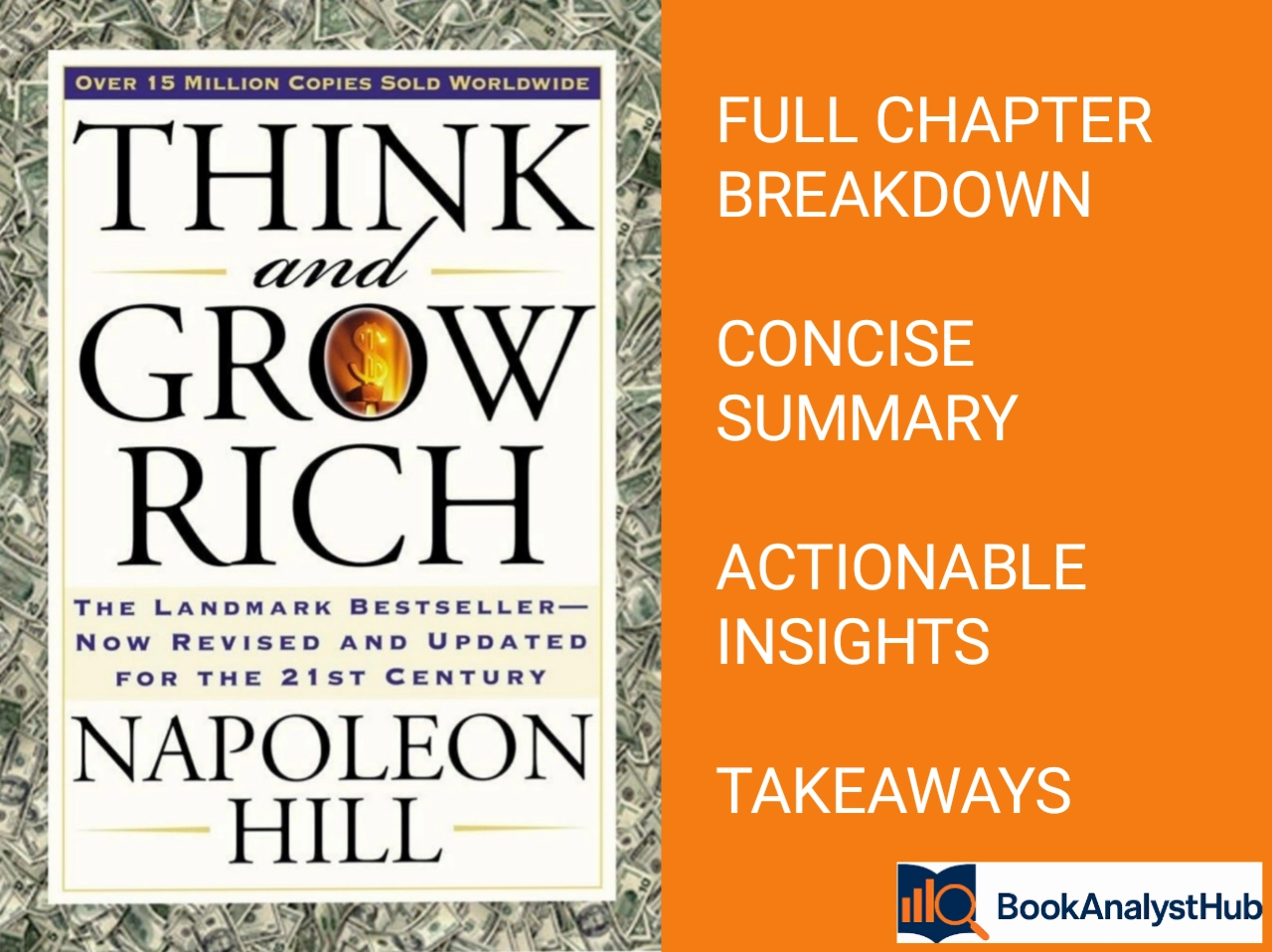
Think and Grow Rich is a timeless classic in the genre of self-help / personal development / business & wealth creation — originally published by Napoleon Hill. Drawing from decades of research and interviews with hundreds of successful people (makers of industry, entrepreneurs, investors), Hill distills a philosophy of success: that wealth and achievement begin in the mind, but require clear purpose, discipline, and right habits.
In this breakdown, I’ll walk you — chapter by chapter — through the core lessons, expand them with simple logic, real-world analogies, and show you how even a beginner can apply them. Think of this as a “mentor’s lecture” drawing from over 20 years of business and investing experience.
🔎 Chapter-by-Chapter Lessons
Introduction (Chapter 1) — “Thoughts Are Things”
- Lesson 1: Your thoughts are the raw material of reality. Everything great you see — a skyscraper, a global brand, a fortune — began as a thought, an idea in someone’s mind. If you want results, start by controlling and directing your thoughts.
- Lesson 2: Clarity of purpose gives direction to your mind. A vague longing doesn’t move mountains; a clearly defined goal does. You must know exactly what you want.
- Lesson 3: Persistent focus amplifies your thoughts. When you keep returning to the same burning idea, you strengthen its hold and increase the chance it manifests.
- Lesson 4: Mindset precedes action. Before you build a business or invest money, build the right mental framework first — because actions flow from thoughts.
- Lesson 5: The difference between dreamers and doers lies in mental discipline. Lots of people dream. Few commit their mind fully. You must discipline your thinking and keep your inner world aligned with your goals.
Why this matters: In companies like Apple or Microsoft — success didn’t start with factories or products. It started with ideas, visions of what might be possible. Without that mental origin, nothing follows.
Chapter 2 — Desire: The Starting Point of All Achievement
- Lesson 1: A “burning desire” is more powerful than a wish. You must transform vague wants into a burning, almost obsessive desire. That heat fuels persistence and action.
- Lesson 2: Be specific about what you want. Define the exact amount (money, profit, growth, etc.), what you’ll give in return, and by when you expect it. Vague goals lead to vague outcomes.
- Lesson 3: Write down your goal and read it daily with emotion. The act of writing + emotionally engaging with your goal embeds it deeper in your psyche — like programming your mind.
- Lesson 4: Having a “give-something-in-return” mindset. Wealth rarely comes free. Know what value or effort you’ll trade for it. This establishes fairness and purpose.
- Lesson 5: Immediate action seals desire’s power. Waiting for “the right time” kills desire. The moment you commit, start acting.
Analogy: Desire is like a spark under coal. Without enough heat (obsession, clarity, plan), the coal remains cold. But with those elements — the fire grows, ignites, and powers a locomotive.
Chapter 3 — Faith: Visualization and Belief in Attainment of Desire
- Lesson 1: Belief turns desire into expectation. Once you truly believe your goal is possible, your mind begins working subconsciously toward it.
- Lesson 2: Visualization strengthens faith. Imagine you already achieved the goal — feel the emotions, see the result, experience the success in your mind. This primes your subconscious to find ways.
- Lesson 3: Faith anchors you during self-doubt. When challenges come — and they will — strong faith keeps you aligned to your goal, preventing hesitation or giving up.
- Lesson 4: Faith conditions the subconscious mind to act without conscious interference. Over time, your subconscious will filter opportunities to align with your goals — you’ll “see” the right doors opening.
- Lesson 5: Faith must be combined with perseverance and plan. Belief without action is wishful thinking; faith + action = results.
Real-world reflection: Many big brands began before their ideas were popular or obvious. Amazon once sold books online when e-commerce was nascent. The founder’s faith kept the business going until infrastructure and demand caught up.
Chapter 4 — Auto-Suggestion: Influencing the Subconscious Mind
- Lesson 1: What you feed your mind matters. Repeated statements or affirmations influence your subconscious beliefs — like programming software.
- Lesson 2: Repetition + emotion = mental conditioning. Saying your goal daily with emotion helps your subconscious accept it as truth.
- Lesson 3: Auto-suggestion builds autopilot habits toward your goal. Over time, your mind begins steering you toward actions aligned with your goals — even when you aren’t consciously thinking about them.
- Lesson 4: Negative thoughts cripple potential. Doubt, fear, hesitation — these are like bad code that corrupts your mental programming. You must filter them out.
- Lesson 5: Auto-suggestion harmonizes with faith and desire to create “success consciousness.” It becomes a mental environment where success is natural, not accidental.
As a mentor: I saw many young entrepreneurs stall because they never reinforced their vision. They’d plan once and forget. The ones who succeeded spoke their goals aloud daily, visualized them — and stuck to them even when results lagged.
Chapter 5 — Specialized Knowledge: Use What Matters, Not Everything
- Lesson 1: General knowledge ≠ power. General facts are common and seldom convert into success. What you need is specialized knowledge relevant to your goal.
- Lesson 2: You don’t need to master everything — you can pool expertise. Like building a great football team: you don’t need to be all-star in every position; you hire or partner with those who have the missing skills.
- Lesson 3: Learn continuously or hire experts. Markets shift, industries evolve. Keep upgrading your knowledge or bring in the right people.
- Lesson 4: Apply knowledge to action; don’t hoard it. Knowledge unused is like a locked treasure. Only when acted upon does it produce value.
- Lesson 5: Leverage collective knowledge through collaboration. Use networks, mentors, advisers — a small but sharp team can beat a big but unfocused solo effort.
Analogy: Knowledge is like tools in a workshop. A craftsman won’t build a house by staring at tools — he selects the right ones for the job and uses them. Similarly, success calls for targeted knowledge, applied with purpose.
Chapter 6 — Imagination: The Workshop of the Mind
- Lesson 1: Every business, product, wealth began as an imagination. Without imagination, there’s no innovation, no breakthrough, no competitive edge.
- Lesson 2: Synthetic imagination — recombining old ideas — leads to incremental advantage. This is how many businesses adapt and improve: combining existing elements in new ways.
- Lesson 3: Creative imagination — generating brand new ideas — leads to exponential success. This is the realm of disruptors, innovators, game-changers.
- Lesson 4: Ideas must be nurtured and sharpened. Imagination is like a muscle — the more you use it, the stronger, more vivid, and practical your visions become.
- Lesson 5: Imagination fuels planning, strategy, and value creation. Without it, your plans are blind guesses; with it — they’re intentional maps toward success.
Real-life example: The rise of Tesla wasn’t just about better cars — it was about imagining a future of sustainable transport, and then combining engineering, design, branding to make it real.
Chapter 7 — Organized Planning: From Wish to Blueprint
- Lesson 1: A goal without a plan is just a dream. Imagination and desire must be channeled into structured, actionable steps.
- Lesson 2: Assemble a team or network (a “Mastermind”) to execute the plan. Collaboration brings complementary skills, better ideas, and accountability.
- Lesson 3: Be ready to revise the plan — flexibility matters. Initial plans may fail. The successful know when to adapt, not abandon.
- Lesson 4: Start immediately — waiting kills momentum. Once you have a plan, launch into action even if conditions aren’t “perfect.”
- Lesson 5: Execution beats perfection. Often, progress matters more than perfection at first. Real-world feedback refines the plan better than ideal planning.
Analogy: Think of planning as the architectural blueprint for a building. You can have the best materials (desire, imagination, skills), but without a blueprint and team, what you build will collapse.
Chapter 8 — Decision: The Mastery of Procrastination
- Lesson 1: Decisive people succeed; procrastinators fail. The sooner you decide and act, the sooner momentum builds.
- Lesson 2: Trust your gut, then refine slowly. Quick, firm decisions create direction; you can always adjust later — but indecision stalls growth.
- Lesson 3: Avoid being swayed by opinions or doubt. Others’ negativities or skepticism often stem from their fears — not your reality.
- Lesson 4: Cultivate the habit of prompt decision-making. Make it a discipline. Over time, it becomes a natural reflex.
- Lesson 5: Decisions must align with your definite purpose. Random decisions drain energy. Strategic decisions build toward your goal.
Business wisdom: Many failed businesses weren’t bad ideas — they were delayed ideas. A good business plan that is never executed because of hesitation stays worthless.
Chapter 9 — Persistence: The Power to Keep Going
- Lesson 1: Giving up is the main reason most fail. Often success is just beyond the point where most people quit.
- Lesson 2: Persistence is built on purpose, plan, and mental conditioning. When desire, faith, and auto-suggestion align — persistence becomes easier.
- Lesson 3: Learn from failure — treat obstacles as feedback, not defeat. Failures refine your path, if you stay committed.
- Lesson 4: Surround yourself with positivity; avoid negative influences. Negative voices sap your will. Persistence thrives on encouragement and belief.
- Lesson 5: Persistence turns intention into results. Daily small steps, repeated over time, compound into major outcomes.
Real-world example: Consider how many startups raise capital, launch products, face setbacks — yet the successful ones are those that keep iterating until they hit product-market fit. Persistence wins.
Chapter 10 — The Power of the Master Mind: Collective Intelligence
- Lesson 1: Two (or more) heads aligned toward the same goal are more powerful than a lone one. Collaboration accelerates growth — by merging skills, resources, ideas.
- Lesson 2: Diversity in the group brings broader perspectives. Combining individuals with different strengths (finance, marketing, operations) results in a more robust plan.
- Lesson 3: Shared energy and mutual encouragement amplify drive. When a group embodies faith, desire, persistence — the collective energy propels each member.
- Lesson 4: Mastermind groups help you overcome blind spots. You see what you cannot alone; you fix what you miss; you strengthen what you overlook.
- Lesson 5: Accountability — groups keep you honest, committed, on track. When you know others are counting on you, you show up, deliver, and persist.
Corporate analogy: Many successful companies are not built by lone founders — but by founding teams, boards, advisory councils. Their combined wisdom, networks, and drive produce outcomes no individual could achieve alone.
Chapter 11 — The Mystery of Sex Transmutation
- Lesson 1: Sexual energy is powerful creative energy. When redirected (transmuted), it becomes drive, ambition, focus — fuel for productivity.
- Lesson 2: Channel emotional and physical energy into creative and business pursuits. Instead of letting it dissipate, convert it into work, innovation, discipline.
- Lesson 3: High vitality often correlates with high output. Many high achievers attribute energy, charisma, perseverance to inner drive — not just intellect.
- Lesson 4: Controlled energy leads to heightened imagination & willpower. When sexual energy is controlled and redirected, mental faculties sharpen, creative output increases.
- Lesson 5: Transmutation can build long-term momentum. Instead of short-lived bursts, you convert raw energy into sustained, productive momentum.
Caveat from experience: This is one of the more esoteric ideas in the book. It doesn’t mean repress or deny natural urges, but channel energy intentionally — like converting fuel into motion rather than letting it burn uselessly.
Chapter 12 — The Subconscious Mind: The Connecting Link
- Lesson 1: The subconscious is the gatekeeper of reality. What you feed your subconscious (through thoughts, emotions, imagination) gets translated into your external reality.
- Lesson 2: Positive emotions + repeated thoughts = subconscious programming. Your habitual thinking sets the default direction of your life — for better or worse.
- Lesson 3: Avoid negativity — fear, doubt, jealousy — because subconscious doesn’t distinguish “good or bad,” it obeys repetition. Negative conditioning blocks success.
- Lesson 4: Use visualization, affirmation, and emotional conviction to plant success ideas deep where conscious doubt can’t interfere. This builds resilience, focus, and subconscious alignment.
- Lesson 5: The subconscious works 24/7 — even when you sleep. That’s why habits matter. Good mental habits continuously prepare you for opportunities, even when you’re resting.
Personal mentoring note: I often tell young investors — your subconscious is like your autopilot. If you program it with fear, scarcity, and negative expectations, you’ll unconsciously sabotage deals. But program it with confidence, optimism, and strategy — it begins to notice opportunities, push you to act.
Chapter 13 — The Brain: A Broadcasting and Receiving Station for Thought
- Lesson 1: Your brain “vibrates” with thoughts — like a radio — and attracts corresponding mental frequencies and people. The ideas you hold strongly attract similar ideas and allies.
- Lesson 2: The better your mental environment (thoughts, beliefs, emotions), the higher the quality of “signals” you broadcast and receive. Surround yourself with success-oriented thoughts and people.
- Lesson 3: Your brain works with the subconscious, imagination, and auto-suggestion to manifest your goals. These components align to produce real-world results.
- Lesson 4: Be mindful of what you allow into your mental “airwaves.” Negative influences, doubts, criticisms — they contaminate your signal.
- Lesson 5: Use your brain actively — think, imagine, plan, expect — don’t let it run on autopilot with random thoughts. Conscious, directed mental effort leads to success; drifting leads to stagnation.
As your mentor: In investing or business negotiations, energy matters. The mindset you bring — optimistic, confident, value-focused — attracts partners, opportunities, deals. Negative or doubtful mindset does opposite.
Chapter 14 — The Sixth Sense: The Door to the Temple of Wisdom
- Lesson 1: The “sixth sense” is intuition — often the source of great insight, “gut decisions,” creative ideas. Once you’ve mastered the earlier principles, your intuition becomes sharper and more reliable.
- Lesson 2: Sixth sense often signals opportunities or dangers before logical mind perceives them. Many entrepreneurs refer to “gut feelings” guiding them away from failure or into opportunity.
- Lesson 3: You can’t force intuition — it develops through discipline, experience, and subconscious alignment. It’s not magic; it’s trained sensitivity.
- Lesson 4: Use sixth sense as a guidance system, not a substitute for planning and action. It’s a guide — not a guarantee. Combine it with intellect, plan and persistence.
- Lesson 5: Trust, but verify — intuition + action + reflection yields success. When you act on a gut feeling, observe results, learn — refine intuitive skills over time.
Example from real business history: Many great corporate pivots — new products, new markets — started as “feelings” or intuition about future demand. The companies that trusted those instincts, took action, often led their industries.
Chapter 15 — How to Outwit the Six Ghosts of Fear
- Lesson 1: Fear is the greatest enemy of success. Common fears: poverty, criticism, ill-health, loss of love, old age, death. These block your mind from thinking big.
- Lesson 2: Identify and acknowledge your fears. You can’t conquer what you don’t see. Recognizing the ghost is first step to defeating it.
- Lesson 3: Use the tools — desire, faith, auto-suggestion, persistence — to override fear. These form mental shields against negativity.
- Lesson 4: Replace fear with positive emotions and constructive thought. Deliberately feed your mind with courage, hope, enthusiasm.
- Lesson 5: Action defeats fear consistently. Fear feeds on inaction. Every step you take — even small — weakens fear’s grip.
Mentor’s note: In my 20 years of business investing, fear — fear of failure, loss, criticism — is the single biggest killer of opportunity. Those who learn to act despite fear, consistently, are the ones who build empires.
✅ Practical Quiz — Test What You’ve Learned
- What is the difference between a wish and a “burning desire”?
- How does visualization strengthen your belief or faith toward a goal?
- Why is specialized knowledge more powerful than general knowledge in building wealth?
- Imagine you have a business goal. Outline a simple daily auto-suggestion practice that aligns with that goal.
- Describe how a “Mastermind” group can accelerate achieving your business or investment goal.
- Give an example of how you might use “imagination” today to push a business idea forward.
- What habit helps you overcome procrastination and indecision according to the book?
- How does persistence turn plans into results, especially when first attempts fail?
- Explain in your own words what “the brain as a broadcasting and receiving station” means for your social and mental environment.
- How can you use your “sixth sense” or intuition in combination with rational planning in business decisions?
❓ Frequently Asked Questions (FAQs)
Q1: Is Think and Grow Rich only about money and getting rich?
A: No. Though money and wealth are often used as concrete goals, the core message is about mastering your mind, building discipline and purpose, and achieving success in any area — business, personal growth, relationships or investments.
Q2: Do I need special education or background to apply its principles?
A: Not at all. The book emphasizes specialized knowledge — but that knowledge can come from learning, experience, or collaboration. What matters more is clarity, mindset, and action.
Q3: Some ideas (like sex transmutation or sixth sense) seem mystical — are they real or practical?
A: Think of them as metaphors for psychological energies. “Sex transmutation” is about redirecting strong life-force energy into productivity and creativity. The “sixth sense” is intuitive judgment developed by experience, discipline, and mental clarity. Used wisely, they’re practical.
Q4: Is it enough to just read the book, or do I need to do something actively?
A: Reading alone does little. Real power comes when you apply the principles — define goals, visualize, plan, act, persist, and condition your mind daily.
Q5: Do I need wealth to start applying these principles?
A: No. You only need your mind, your clarity, and willingness to act. Many successful people started with nothing but desire, belief, and persistent action.
Q6: Can the “Mastermind” concept work today, in modern digital/remote world?
A: Absolutely. Mastermind groups can be virtual — using online meetings, collaborations, networks. The core value remains: collective thinking, shared motivation, accountability.
Q7: What if I fail many times before succeeding?
A: That’s expected. According to the book, persistence through failures differentiates winners from quitters. Each failure is feedback — refine, adapt, continue.
Q8: Is the book outdated because it was written decades ago?
A: Not really. While examples are old, the psychological principles — mindset, goal setting, discipline — remain timeless. They still apply today, perhaps more than ever.
Q9: Does this mindset guarantee I’ll become rich?
A: No guarantee — because success also depends on execution, market conditions, circumstances. But the mindset dramatically increases your probability of success.
Q10: How soon will I see results if I apply these principles?
A: It varies. Some people see changes quickly; for others, building momentum takes time. Think long-term, stay consistent, and treat it like building a habit.
🎯 Overall Review & Rating
As a business veteran and book-nerd with over 20 years’ experience: Think and Grow Rich remains one of the most powerful, foundational books for anyone serious about entrepreneurship, business or investment. Its strength is in its timeless psychology of success — not outdated tactics, but enduring principles about mind, purpose, and action.
Rating: 4.7 out of 5 — It loses points only because some chapters (like sex transmutation or sixth sense) require open-mindedness and self-interpretation, and because real-world application depends on your consistency. But as a framework for mindset and growth — it’s near perfect.
🛒 Where to Buy Think and Grow Rich Online (Cheapest Price in USD)
I checked a number of major online bookstores for availability and current prices of Think and Grow Rich by Napoleon Hill. Here’s what I found — and where you’ll most likely get the cheapest price worldwide (in USD).
📚 Where “Think and Grow Rich” Is Available & Their Prices
Price Snapshot (at Etsy)
- The cheapest available copy I found online right now is — listed at roughly USD $2.00–3.34 (depending on the seller).
- Another available edition is priced at about USD $13.62.
- There is also a hardcover vintage option but at a much higher cost (about USD $50.00).
Other Mainstream Bookstores
- On major retailers like Walmart, one paperback edition is selling for about USD $6.80.
- Newer or updated paperback editions at some bookstores go for around USD $9.31.
- More expensive new editions — from some big retailers — list the book in the range of USD $11.00–$19.99.
✅ Best Option: Cheapest Price Worldwide
If you want the cheapest price in a globally recognized currency (USD), going for the used/affordable edition — Think and Grow Rich (used / affordable edition) priced around USD $2.00–3.34 — is your best bet. That is by far cheaper than any new edition currently widely available.
Why this is the best pick:
- Significantly lower than mainstream retail price.
- Accessible globally (depending on seller’s shipping).
- It gives you the same original content, so for learning and personal development purposes — it serves perfectly well.
See Also: